
A Travelogue on Tel Aviv, Jaffa, and Bethlehem. Points of Interest.
How long is the long line of people waiting to visit some of the holy sites, where was the woman Tabitha resurrected, and what is the ancient city of Jaffa known for? Read about this and other interesting facts in this travelogue about Tel Aviv and Bethlehem, part of the travelogue series “Israel—The Land of God.”
YOU CAN FIND MORE INFORMATION ABOUT ISRAEL AND A WHOLE SERIES OF TRAVELOGUES ABOUT ISRAEL HERE
THE BEGINNING
The trip began right on the night after Women’s Day. On March 9, at just 2:30 p.m., our group from Plovdiv gathered and boarded the bus that took us directly to Sofia Airport, Terminal 1. We flew with Wizz Air on a 6:40 a.m. flight and landed at Ben Gurion Airport in Tel Aviv at 9:05 a.m.
My parents also came along on the trip—it was their first flight ever—and it was fun to watch them from the sidelines. When you’ve flown dozens of times, you somehow forget the thrill and excitement that first-time travelers experience. Another thing is that my parents don’t know a word of English, and yet they haggled extremely successfully with the street vendors at the Jerusalem market and got prices that I’d be too embarrassed to even think about…


Ben Gurion Airport
The airport in Tel Aviv is named after the first prime minister of the modern State of Israel—David Ben-Gurion. There are several security checks to go through at the airport terminal. First, passport scanning + a photo taken on the spot + issuance of a tourist visa (i.e., a small piece of cardboard that can easily be lost anywhere). The Israeli visa is not affixed to the passport. Next comes a baggage check. And finally, a few individual questions for each prospective pilgrim, such as: “What is the purpose of your visit to Israel?”, “What does your name mean?”, “Are you carrying any items placed in your luggage by other people?”, “Do you plan to meet anyone you know in Israel?” It is very important to give unambiguous answers, to tell the truth, and to be mindful of your body language.
So, Tel Aviv Airport was our point of entry into Israel and the place where the group gathered. The tour guide handed out headset-style transmitters to each of us, which allowed us to hear his instructions and explanations from a distance of nearly 200 meters without having to jostle each other. A very useful gadget.
When we got on the bus, we were seated in the order in which we had signed up. I ended up sitting with a young, friendly family whom I met for the first time then, but we later became friends. Throughout the entire trip, we traveled in a large, 50+-seat local bus with air conditioning and a one-of-a-kind Arab driver who kept us entertained with his jokes and created a great atmosphere during the trips.
–> Browse and book a budget hotel in Tel Aviv at a discount. Check it out HERE!

TEL AVIV
Tel Aviv means “Spring Hill.” For many years, it was the country’s capital. Today, Israel’s official capital is Jerusalem, but most administrative buildings are located in Tel Aviv. Modern Tel Aviv is just over 100 years old (founded in 1909). Before that, the area was covered in sand dunes. Today, however, about one-third of Israel’s population lives in Tel Aviv and its suburbs. Read more about Tel Aviv in the travelogue from my previous trip there, where we spent a full three days exploring this modern Mediterranean city. Check it out HERE.
On this tour, however, we had only a few hours, which we spent mainly in Tel Aviv’s Old City, known as Jaffa (or Yafo, or by its ancient name, Yopia), after which we headed to our hotel in Bethlehem.


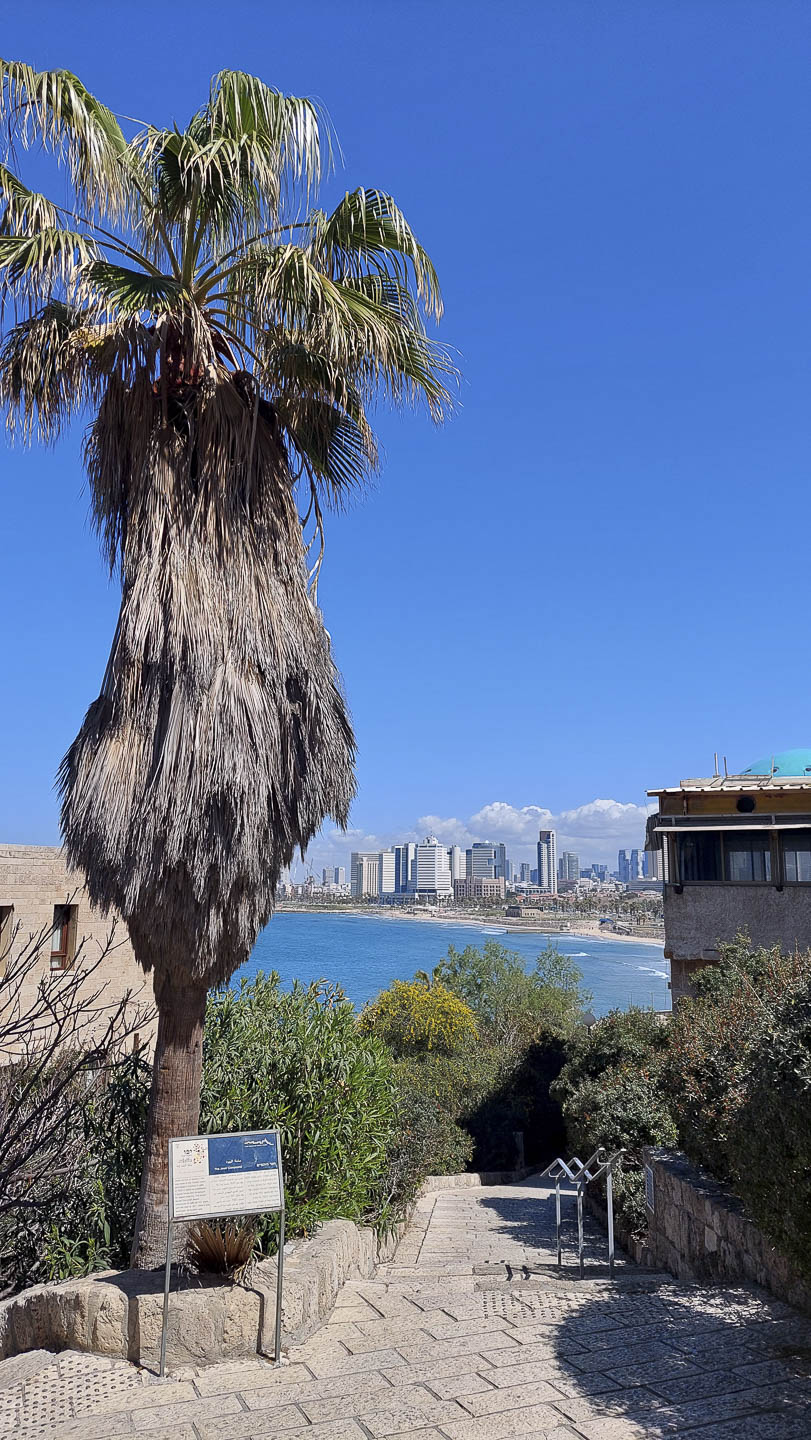


What is Jaffa known for?
– One of the oldest ports in the world is located here.
– The prophet Jonah boarded a ship in Jaffa in an attempt to flee from God and from His mission to send him to Nineveh.
– This is also where the house of Simon the tanner is located; on its roof, God appeared to the Apostle Peter and spoke to him about reaching the Gentiles for Christ.
– The resurrection of a woman named Tabitha took place in one of the houses in Jaffa.
– “Jaffa” is the name of one of the four varieties of oranges. One of the city’s main attractions is the hanging orange tree

Bethlehem
We had about an hour for a leisurely stroll and some shopping, after which we boarded the bus and headed for Bethlehem. It was interesting to observe how, as we traveled deeper into Israel—from the lush Mediterranean vegetation and abundance of palm trees and flowers everywhere in Tel Aviv—the landscape became drier and the vegetation significantly decreased. The distance between Tel Aviv and Bethlehem is about 70 km, and the trip takes 1 hour and 10 minutes.
Jesus’s hometown is located in Palestinian territory. Bethlehem (Hebrew) means “House of Bread.” Israel has built an 8-meter-high wall of concrete panels, topped with barbed wire, to protect against Palestinian terrorists who, blinded by hatred toward Jews, sometimes carry out suicide bombings in Israel. Security at the checkpoint is extremely tight—Israeli military personnel inspect every car and passenger coming from Palestine. In the opposite direction—from Israel to Palestine—there are almost no checks.
The Santa Maria Hotel was our home for the next 5 days. The hotel wasn’t luxurious, but it had everything one needs, especially when you leave in the morning around 8–9 a.m. and return in the evening around 7–8 p.m. The food was average; it was mostly local and traditional Jewish-Palestinian cuisine, with European dishes appearing less frequently.
–> Browse and book a budget hotel in Bethlehem at a discount. Check it out HERE!


 Christmas


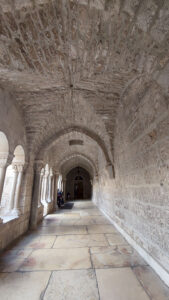
After we checked into the hotel, the group quickly gathered and we went to the nearby Basilica of the Nativity. This is the supposed site of the Nativity. Krassi, our tour guide, explained that there were always very long lines and that you had to wait several hours to see the “holy” site. The courtyard was half-empty, and I thought that by the end of the day there probably wouldn’t be that many people. Yeah, right! We went inside, and I couldn’t believe how so many people could be waiting for something like this. The line was enormous (at least 200 people) and moved slowly. No one from our group joined the line. An interesting fact was that Catholics are only allowed to view the site through a small peephole.
To wrap things up—here’s something really interesting: Only a Christian can be mayor of Bethlehem. On the other hand, the keys to the Church of the Holy Sepulcher are held by a Muslim family. More on that in the next travelogue.
If you'd like to get a refund for part of the amount you paid for hotels, airline tickets, or products, sign up at this link HERE—every new user receives a bonus of up to $10 in their account.

