
Crete travelogue: itinerary, sights, expenses, tips, impressions
Any normal person would say that it is not a good idea to go to the island of Crete in the height of summer, because at this time of the year the temperatures there are unbearably high. But after my son broke his wrist right at the beginning of the summer and thus failed our planned vacation in Antalya with a huge number of water parks included, we decided that although already in the middle of summer it was time to visit a new place, unknown to us - Crete. Long delayed, but here came his star hour.
Be sure to read the article with the most beautiful beaches in Crete - here.

Rental car
(Or, to put it another way—When, for heaven's sake, are we finally going to rent a decent car without any problems?)
We wondered in advance whether to rent a car or to try to visit the famous beaches with the help of intercity public transport + organized tours for the more difficult to access. In the end, however, after seeing that the bill actually comes out exactly the same, not including the convenience and freedom of independent car travel, we definitely settled on the option of renting a car.
 After a long search on the Internet, we decided to rent a car from Monza. For 8 days, the price was 248 euros including full insurance. However, the car they gave us turned out to be a complete mess. Elementary extras were missing. Good thing at least there was air conditioning and it was working! Oh miracle!
On the second day, we spent half an hour trying to unlock the car. The same thing happened to us a few more times, and it was especially “pleasant” when we were already heading home, sunburned from the beach, and wanted to get into the car a second faster to turn the AC on full blast—and at that very moment, the car acted up again and wouldn’t unlock. We called the rental car company about these issues, and they told us there was some kind of glitch with the door and the lock that they had “accidentally” failed to mention to us. In the end, the automatic locking system wasn’t working, and we had to unlock the car with a key. In the 21st century! Yeah.
If you do decide to travel around Crete by bus, here is THIS is the website with information and schedules for intercity buses.
COVID
On the occasion of the COVID19 pandemic, which has been spreading worldwide for more than 1 year, there was almost no measures in Crete at the time (July 2021). It was necessary to fill out a PLF form before boarding the plane up to 24 hours before the trip. See here.
We, the parents, were vaccinated and did not need to do any additional tests before or after arrival, and the children under 12 were exempted from everything. In general, Crete's anti-epidemic rules were to always wear a mask indoors and we followed them, but we noticed that in many places, especially in grocery stores, tourists came in without masks and no one was paying attention to them. Sellers and waiters, for their part, were constantly wearing masks, even some restaurants self-promoting that all their staff were vaccinated. 🙂


hotel and the area around it

 Overnight stays in Western Crete in the height of summer were not cheap at all. The only thing I kept was where we would spend the night to be west of Chania to be closer to the wow beaches.
So we finally settled on Aris Apartments in Gerani. In general - basic level of accommodation, private bathroom, beautiful common areas and garden and a magnificent bakery next door, managed by a Bulgarian woman. The name of the bakery was Konteka. The apartment was located on a main road and it was terribly noisy at night, and the air conditioning was paid extra - something that was not mentioned in the price in advance. Overall, we were disappointed with the accommodation and would not recommend it. (View other budget hotels in Crete here)
Our hotel was located in the village of Gerani, where, apart from the great bakery right next to our apartment, there was really no other interesting thing. There was a lively street for evening walks. That's why some of the evenings we walked in the neighboring town - Platanias, where life was bubbling and where the most attractive restaurant of our vacation was located, namely - Mylos garden restaurant.
Everything in this restaurant was somewhat directed to and towards nature. Already with our placement at the table, the waiters gave all the ladies natural flowers to hang on our hair. Almost all the tables in the restaurant were pre-booked and we took one of the last available. The restaurant's toilets were wow – all in fresh natural flowers! The tables were full of different varieties of real tomatoes, chives and others. Unique atmosphere. And at the end of the dinner they surprised us with dessert - a huge platter of fruit, served in an extremely attractive way - with dry alcohol.
–> Browse and book a budget hotel on the island of Crete at a discount. See HERE!


Daily regime
Our days on the island of Crete passed in a monotonous routine—every morning we’d stop by the nearby bakery to buy at least one or two bags of snacks, croissants, pizzas, and the like, “to have for the road.” I still remember those wonderful chocolate and strawberry croissants that melted on my lips in the heat…
After that, we’d get in the car and head to a different beach every day; in every case, the drive took about an hour to an hour and a half each way. We’d arrive at the beach around 11 a.m. or noon; the sun was already beating down hard, and from the very first day we learned the hard way that on the island of Crete at the end of July, no sunscreen helps. We all got sunburned there more than anywhere else we’d ever been, simply because we were going to the beaches right in the middle of the hottest part of the day. After 3–4 hours on the ultra-mega-hyper-super awesome beaches, we’d head back to the apartment, where we’d each take a shower and have a little time to ourselves (read: Internet time & gaming :) ), and in the evening we’d head out to explore different spots.


Program:
During our summer vacation on the island of Crete, we spent four days visiting four of the island’s top beaches, some of which are ranked among the most beautiful beaches in Europe. One day we went to a water park—after all, what’s a vacation with kids without a water park? We set aside the other two days for cultural activities in the larger cities—namely, a stroll through Rethymno plus a visit to an olive factory and a cave on one day, and a city walk through Chania. (Personal opinion—Rethymno is much more charming than Chania. Chania is the second-largest city on Crete, while Rethymno is the third-largest.) These two days served a practical purpose: to give our sunburned skin a chance to heal a bit by keeping it out of the sun, at least for a little while.
Day 1: Flight: Sofia - Chania with Wizz Air, departs at 19:55 and lands at 21:30
Accommodation in the apartment - Aris Apartments, Gerani (see other budget hotels here)
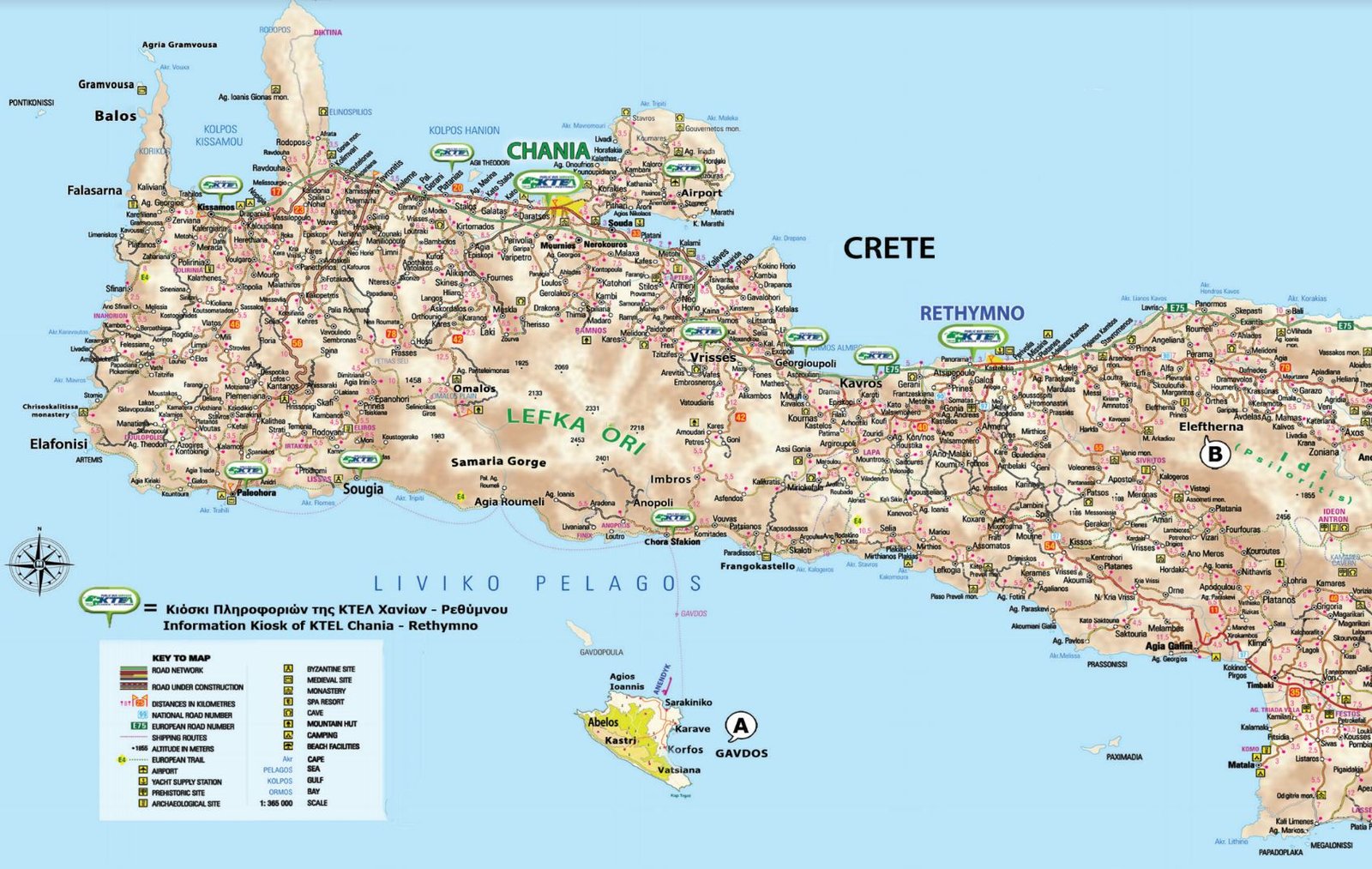
Day 2: Beach Balos – 41 km. (for about an hour and a half)
Day 3: Beach Elafonisi – 65 km. (for about an hour and a half)
Day 4: Olive oil factory + Melidoni Cave + Rethymno City
Day 5: Aquapark (https://limnoopolis.gr/)
Day 6: A leisure day, someone from the nearby beaches + a walk around Hania City Chania City
Day 7: Beach Falassarna – 42 km. (for 45 min.)
Day 8: In search of carriage-carriage + beach Seitan Limania
Flight: Chania - Sofia - with Wizz Air, takes off in 22:10 and lands at 11:45 p.m.


Interesting attractions in Chania are:
1. The old town of Chania - charming narrow streets where one would gladly get lost.
2. The Venetian port, along which small cute cafes and restaurants are lined up next to each other. Built by the Venetians in the 14th century, the huge harbor was a strategic base for fighting piracy, which was then widespread in the Mediterranean Sea.
3. The Egyptian lighthouse - an emblem of Chania. It was built by the Venetians, then neglected by the Ottomans and rebuilt again by the Egyptians.
4. The Maritime Museum - full of maritime charts and exhibits that tell about the history and seafaring traditions of Crete and Chania.
5. Firka fortress - it is a monument of primary importance for the entire island, because it was here, on 01.12.1913, that the official ceremony took place and the Greek flag was raised as a sign of the unification of the island of Crete and Greece.
6. The Janissary Mosque - It is located on the harbor in Chania and is the oldest Ottoman building in the whole of Crete.
If you also want to get back part of the paid amount for hotels, flights or products, register at this link HERE and every new user receives a $10 bonus in the account.


Interesting sights in Rethymno are:
1. The old town of Rethymno - again narrow streets filled with many flowers, stalls, life...
2. Forteza fortress - this is the Venetian fortress, which is located on the hill of Palekastro and from which you can see the city from above. Behind the walls of the fortress was an ancient city with buildings, church, etc.. Fortezza hosts cultural events every summer that attract numerous residents and tourists.
3. The Rimondi Fountain - built in 1626 and continues to work until today.- City beach
4. City beach
5. Melidoni cave - located 38 km. from Rethymno
6. Paraschakis Olive Oil olive oil factory - located 38 km. From Rethymno, right next to Melidoni Cave


Crete Island - Personal Impressions
The island of Crete is a huge island. Really huge. For 8 days, we still had more beaches in Western Crete that we couldn't visit, but at least we managed to check off the most popular and most beautiful beaches.
What amazed us was that in many places in Western Crete there were no normal forests like those in Bulgaria—made up of pine, beech, ash, or maple—but rather “unusual” forests—made up of olive trees. As far as the eye could see—nothing but olive trees. Entire hills covered with olive trees. We hadn’t seen anything like that anywhere else in Greece.
The bad thing was that the olive trees were purposefully kept low, and for this reason the shade of the island of Crete was in a huge deficit. There was almost no shadow on the road. Peck. zest. And Peck again. 🙂


 Crete is unofficially known for growing cannabis. If you go around it enough, you will encounter many covered greenhouses. It is possible to grow this "grass" there. It is said that it is this "Agriculture" that gives an impetus to the economy of the island.
During the warmer months of the year, the island of Crete can be seen carriage-carriage turtles that often come out of the sea at night and go to the shore to lay their eggs there. They then bury them and return to the sea. In several places we saw designations for nests with turtle eggs. I knew there were volunteers who made sure to ensure that this whole egg process was as secure as possible.
The last morning of our vacation, at 6:30. I went to the beach in Gerani to see if there were or weren't turtles in Crete with the eyes. And it was at this time that the volunteers were passing by to record the new nests with eggs that appeared last night and repair the path of the nests, whose eggs should soon hatch and the little turtles should successfully reach the water. It was quite exciting because I saw the tracks of turtles that had made 2 nests with eggs only a few hours earlier in the night. I have tracked the entire process of marking and marking the socket.


Expenses for 2 adults + 2 children:
– Flights Sofia–Chania–Sofia: 234 BGN
– 7 nights at Aris Apartments, Gerani – 323 euros
– Car rental – 248 euros
– Water park – admission fee of 60–70 euros for everyone
– Food and other expenses – at least 800 BGN, because we treated ourselves almost every night and had dinner at a restaurant.
Total: BGN 2,350 (total for 2 adults and 2 children aged 6 years and 10)
Be sure to read the article with the most beautiful beaches in Crete - here.
Like my page on FACEBOOK to be the first to hear about new travel stories and great deals!


