
True adventure with bus and trekking in the Himalayas
MORE ABOUT OUR ENTIRE ROUTE AND THE WALKS WE MADE IN NEPAL – see HERE.
What is it like to cover 300 km for a grueling 21 hours in a Nepalese intercity bus, to eat yak steak, what is it like to be in the center of the Nepalese Himalayas, surrounded by some of the highest peaks in the world and what is it like to fly over them with a small plane – read in the next travelogue about Nepal.
 READ THE FIRST TRAVELOGUE ABOUT NEPAL AS WELL: KATHMANDU – SEE HERE
The most popular thing you can do in Nepal is a mountain trek in the Himalayas or the so-called trekking. Nepal is one of the top destinations for this type of activity and many tourists visit the country solely for this purpose.
I thought for a long time about what our trek should be like given the short time we had. We could spare a maximum of seven days. The options were not many and the most recommended short trek started from Pokhara and reached Poonhill peak, from where a panoramic view of the 3 eight-thousanders in the Annapurna region would open up.
Our desire, however, was not just to stay away and look at panoramic views of the mountains, but to go deep into the mountains themselves. To see the authentic village way of life of typical Nepalese people.
–> Browse and book a budget hotel in Pokhara with a discount. See HERE!
The final version of our trek looked like this:
Day 1 and Day 2: Direct bus from Kathmandu to the town of Jomsom in the Mustang region and from there trekking to the village of Kagbeni.
Day 3: The next day from Kagbeni trek to a temple in Muktinath – one of the most famous and important Hindu and Buddhist pilgrimage centers and back.
Day 4: Bus back from Jomsom to Tatopani, to save ourselves walking on the road
Day 5 – Day 7: The standard Poonhill Trek to Pokhara

 We wanted to make this route completely independently, without an agency and without a guide. To this end, while we were in Kathmandu, we went to the Nepal Tourism Board and got two types of permits (authorizations), without which we had no right to trek in the Himalayan mountains. One was ACAP (Annapurna Conservation Area Permit), which gave us access to the Annapurna mountain. This permit can be obtained at the Nepal Tourism Board both in Kathmandu and in Pokhara and costs 2000 rupees/person (20 usd). Keep in mind that these are government institutions and work from Monday to Friday with normal working hours. The other necessary permit was TIMS (Trekkers’ Information Management Systems), which serves to track trekkers and in case of need – to search for and assist them. You can get it from any Tourist Service Center (working hours 10 – 16h. every day) or possibly from TAAN (Treking Agencies Association of Nepal). Again it costs 2000 rupees/person. For both permits, a total of four photos are required. Don't worry if you don't carry photos, because you can be photographed on the spot for free. When filling out the application, you will need to enter passport details and the days and route of the trek, as well as whether you have decided to be with an agency, with a guide only, or completely independently. In principle, if you are on an organized tour, there is no need to trudge to the Nepal Tourism Board for permits, because your agency will organize all this and get them for you instead.
Like my page on FACEBOOK to be the first to hear about new travel stories and great deals!
And so, we had the permits in hand, we also had a devised route that we wanted to take, and the day came to take the direct bus from Kathmandu to Jomsom. There was very little information on the internet about such a direct bus, but finally I found an agency (Nepal Kailash Trekking) that offered exactly such a thing for a price of 1800 rupees, which is about 18 dollars/person. The duration of the journey was 17 hours. We bought the bus tickets over the phone by calling the agency and shortly after they were brought to our hotel.


The bus for Jomsom departed from Balaju New Station in Kathmandu. The distance from our hotel to the bus station was not large, so we walked it. On the way we saw the slum of Kathmandu and again very, very much dust everywhere. You could even smell the dust. We arrived at the bus station quite early and while waiting we bought strength from a snack bar typical for Nepal MO-MO, but by the piece. When we asked how much it costs, the man quietly said “fifty” (50 in eng.). We took two pieces and gave 100 rupees. The seller was a little confused whether to give us change. Finally he gave us 70 back and everything was OK. Very often in Nepal they liked to rip off tourists by saying fifty instead of fifteen.
The bus was merrily-exotically colorful on the outside. Inside it was clean and smelled pleasant. It had about 24 seats while up front by the driver there were at least another four-five seats. The bus did not have a luggage compartment. Therefore, all larger cargo was loaded up top on the roof. There was a ladder by which the conductor climbed up and carried the luggage. After all cargo was loaded, he placed a waterproof cover on top, tied it from all sides and we set off.
The entire journey on this bus turned out to be an incredible once-in-a-lifetime experience. We would never repeat it, but then again we wouldn't have felt the atmosphere and life in Nepal so well if it wasn't for this trip. It was exceptionally interesting and we felt like real Nepalis. The trip was supposed to last 17 hours on schedule, but actually lasted 21 hours!
Right upon leaving Kathmandu we passed through some of the outer neighborhoods to pick up more passengers. Everything happened very slowly and calmly, at least for the Nepalis – they are used to it. Every time we waited about 10-15 minutes for the passenger to arrive and for their ticket to be checked and luggage loaded upstairs and time passed... Along the way at some of the stops people would climb in and out to sell us chips, shawls and other such things. There were also people who sold the exact same things through the windows of the bus.


The bus route was as follows: Kathmandu-Pokhara-Beni-Tatopani-Marpha-Jomsom. These were also the officially recognized stops. It is another matter that we stopped a minimum of 200 more times to pick up and drop passengers, pee breaks, changing a flat tire and many other reasons.
The Kathmandu-Pokhara road is considered the best road in the country and the Nepalis call it the highway. We set off from the bus station in Kathmandu at 3 PM and the first three hours of the journey we didn't realize at all that this was supposed to be the highway, since Kathmandu turned out to be a huge town and there are multiple small towns connected to it. Therefore, the first three hours we only passed through populated areas.


Only after that did we get on the so-called "highway", which was simply a single-lane road with perhaps truly the best asphalt in the country (perhaps simply because in other places it was completely missing). Traffic was heavy, there were many trucks, which did not allow fast driving on the "highway".
The atmosphere in the bus was very interesting. We were the only white people inside. There were two other tourists – Buddhist monks, everyone else was typical Nepali. For the 21 hours of travel only 6 hours were in silence. The rest of the time we listened to typical Nepali-Indian music and watched local Planet TV. Something that made an impression on me is that the model for women in Nepal is slightly curvier than in Western countries.
On the Internet, even before the trip, I had read that there was a danger of being robbed on night buses in Nepal. When it got dark, the driver would stop and pick up some guys who would sit right in the middle of the aisle, and when the passengers fell asleep, they would go through their bags, pockets, and luggage, and then get off completely unbothered, without anyone noticing anything. And so... as we were traveling, it started to get dark and the driver started picking up some passengers, who in turn started sitting right in the middle of the aisle. Everything went exactly according to the scenario I had read beforehand on the Internet. Being responsible tourists and suspicious of everyone and everything like Bulgarians, we kept all our luggage with us in our hands and at our feet, so the chance of us being robbed was zero. In the end, we had no problem with these passengers who got on later in the dark. There were no people robbed, it just got "a little" crowded in the bus because the aisle was taken up both by people and their luggage.
We arrived in Pokhara after a seven-and-a-half-hour drive, at 23:30. I personally was so exhausted from the music and the hubbub of the suspicious people getting on and off the bus that I was ready to get off and change our plans for the next few days. Simeon, however, stopped me and we continued.
I had also read that the road to Beni was said to be a nice highway, but, God, if that's a nice road, then I'm a goat…!!! It turned out that the road is strewn with potholes, even at times we drove on stones, on gravel, unpaved road, even on this section of the route WE HAD A FLAT TIRE AT 1 AM! It took about an hour for the boys to change it, which delayed us further.


Meanwhile, let me mention that the bus staff consisted not only of a driver and a conductor, but a driver + 2-3 young guys who helped wherever and whenever needed – with changing a tire, loading and unloading luggage from the roof, and later they would help move fallen rocks along the road to Jomsom.
We were very worried about this long bus journey, wondering if and where we would stop to use the toilet, but it really turned out to be no problem and the driver stopped every three to four hours for a pee break 🙂. There were even three places along the route where we could sit down and have a bite in peace. Yes, but all the cooked food was prepared like for themselves – SPICY, and our delicate European palates couldn't handle the taste and we stayed hungry.
 The rest of the road from Beni to Jomsom was a miracle. The road was a mixture of stones, gravel, dirt, and a huge amount of dust. We are going to the mountains to escape the dust of the capital Kathmandu, and it turned out that the Himalayas are very rocky mountains and there is dust everywhere. The road to Jomsom passed through exceptionally high and scary dangerous roads. For the entire route, the average speed was 50 km/h, while when we started climbing the Himalayas it dropped to 5 to 10 km/h. Many times the guys from the bus got off to move fallen rocks from the road. Also along the way we saw a forest fire. Not only that the Himalayan mountains are almost devoid of any vegetation, but now this fire was going to completely destroy it. The mountain villages we passed through were very small and looked very ordinary.
We crossed a river several times with the bus!
But not on a bridge, but like this – right through the river in the literal sense of the word 🙂
The road to Jomsom runs parallel to a river and several times our bus crossed right through the river off-road.
To be honest, I didn't think I would be able to endure 21 hours sitting in one place, but we finally arrived in Jomsom. Looking around, we saw that we were surrounded by high mountains on all sides, and in the distance even higher white peaks could be seen – those of the 8-thousanders.
If you also want to get back a portion of what you spent on hotels, flights, or products, register at this link HERE and every new user receives up to a $10 bonus in their account.


From the roof of the bus, water heaters, bathroom tiles, quilts, and all sorts of other things that people carried with them began to be unloaded.
The first thing we saw when we hit the road was an ACAP office, where we registered our entry into the Annapurna mountains and marked Jomsom as the starting point of our route. From there we set off for Kagbeni. The road there was 10 km, and we crossed it in about 3 hours. Jomsom and Kagbeni are at almost the same altitude – about 2800 meters. Along the way we cut across two lakes, which at the time were completely dry. There were jeep and moped drivers who were also cutting across. We assume that during the monsoon season all this will be covered with water.


Mustang region is a very famous region in Nepal and is divided into Upper and Lower Mustang. Lower Mustang is accessible with the permits we got – ACAP and TIMS, while Upper Mustang is considered a restricted area due to its proximity and border with Tibet and requires a different permit which is quite expensive and charged per day. The town of Jomsom, Kagbeni, and Muktinath are the places in Lower Mustang that we had planned to visit.
We reached the village of Kagbeni. Up to there, however, we got very tired – whether it was from the high altitude, or from the long 21-hour bus ride, after much thought we decided that we didn't want to do the whole trek that we had invented and planned. So we decided to stay there for the night and the next day return to Jomsom and from there whatever happens… J The next day we were supposed by plan to walk to the famous temple in Muktinath, but since the distance there and back was 16 km. + elevation gain of 1000 m., which seemed like a lot to us, and we were not prepared – neither mentally, nor physically, nor in terms of luggage and equipment. Another thing that put us off was the cold or rather the constant cold everywhere. The people there do not have air conditioners, and they don't light fireplaces, so whatever it is outside is what it is inside the room itself. Only under the covers was it warmer 🙂
Kagbeni turned out to be a very interesting small village with typical stone buildings and a natural way of life. I had previously booked via Booking.com the hotel YacDonald’s with the note that on Booking.com it is difficult to find accommodation in Annapurna and this hotel was one of the few possible. Most trekkers find accommodation on the spot by arriving at the designated settlement.


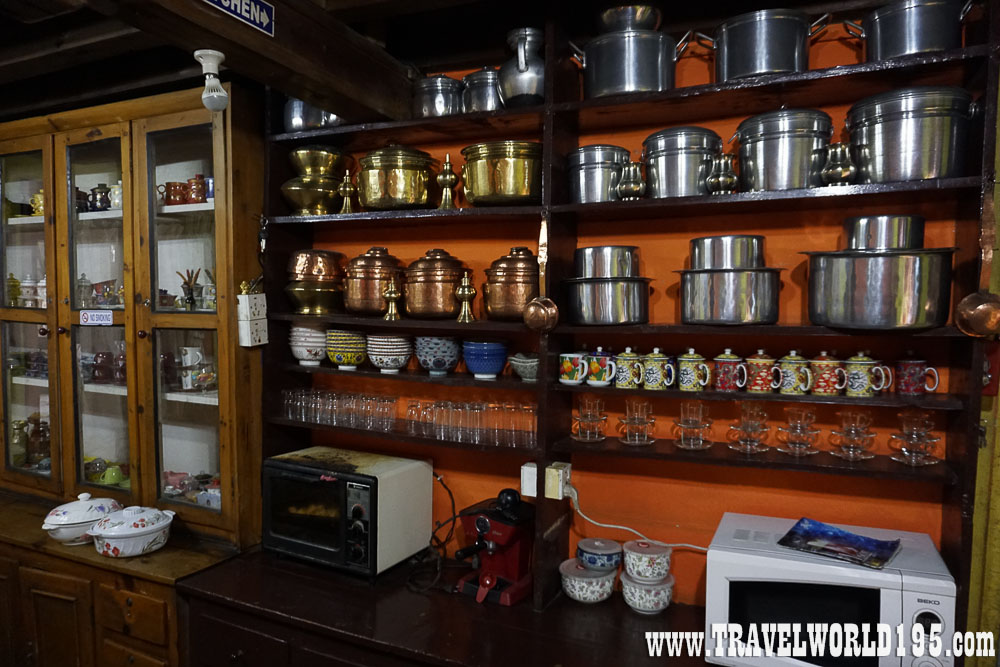


Our hotel turned out to be uniquely colorful and cozy, typical for this region. By default, the menu included all kinds of yak dishes – yak steak, yak spaghetti, yak soup, yak omelet, and so on.

 We settled into the room, took a hot shower, and lay down to sleep for a little while after the long bus transfer. Around 6 p.m. we woke up, it had just gotten dark, we turned on the light and exactly after 10 seconds the power went out! It turned out that in the Himalayas every day both morning and evening, there is a power schedule. Also in the rooms, not only in this hotel, but as a rule in all mountain accommodation places, the rooms had neither an air conditioner nor a stove – nothing to warm a freezing person… We slept as if we were sleeping outside – at such degrees. Fortunately at least the kitchen worked, because people there cooked on gas and at least we wouldn't stay hungry. Freezing, at least we'll eat, we tell ourselves… Yes, but no! The prices there turned out to be triple and quadruple the normal prices, but we had no choice.
Finally we went to bed huddled under several layers of thick quilts.


We settled into the room, took a hot shower, and lay down to sleep for a little while after the long bus transfer. Around 6 p.m. we woke up, it had just gotten dark, we turned on the light and exactly after 10 seconds the power went out! It turned out that in the Himalayas every day both morning and evening, there is a power schedule. Also in the rooms, not only in this hotel, but as a rule in all mountain accommodation places, the rooms had neither an air conditioner nor a stove – nothing to warm a freezing person… We slept as if we were sleeping outside – at such degrees. Fortunately at least the kitchen worked, because people there cooked on gas and at least we wouldn't stay hungry. Freezing, at least we'll eat, we tell ourselves… Yes, but no! The prices there turned out to be triple and quadruple the normal prices, but we had no choice.
Finally we went to bed huddled under several layers of thick quilts.


A little useful information and tips for people planning a trek in the Himalayas:
- Check in advance what permits you need for the place you are going to and be sure to get them. Keep in mind that if you are caught without a permit, you will have to get one on the spot at a double price.
- Water in the Himalayas. As expected there, as everywhere else in Nepal, tap water is polluted and unfit for drinking. Unfortunately, bottled water in shops costs at least four times the normal price. Therefore, you are left with 2 options: either the so-called Safe Drinking Water Station, where for a certain amount (40-50 rupees) you can fill up with ozone-purified water, OR purify the water yourselves using special tablets. I advise you to get tablets on the spot in Nepal, because they are much cheaper on the way than if you buy them in BG.
- Вземете предвид височиннта болет! Това не е шега работа и понякога има фатални случаи! Бавно напредвайте във височина – не повече от 500 м. денивелация на ден. Пийте по 3 литра на ден, местните препоръчват “чеснова супа”. Ибягвайте алкохола и кофеина. Ако въпреки това се почувствате зле ( главоболия, повръщане, замаяност, липса на равновесие ) непременно отидете на по-ниска надморска височина.
- Do not neglect thermal clothes and underwear. Equip yourself with the necessary trekking equipment – backpack, clothes, shoes. It really is cold in the mountains!
- Do not eat, smoke, or make noise near local temples and monasteries. Always take off your shoes before entering a temple.
- Когато се здрависвате, не подавайте ръка, а съберете двете ръце като за молитва и кажете ” Намасте” – израз за поздрав на непалски.
- Take a copy of your passport and a copy of your travel insurance with you.
- Do not rely on the internet in the mountains. Take paper maps and a compass.
- When someone hands you something, take it with both hands. The same goes when you are giving something.
- Do not use your left hand (it is considered unclean).
- Always ask for permission when you want to take a photo of someone.
- Think about the environment – do not litter, throw away batteries or plastic bags.
- Do not eat beef in front of Hindus and Buddhists – cows are sacred to them. Do not wear leather.


 The next morning, we woke up to cold and frost once again. We took a morning walk around the village and saw various livestock – cows, sheep, horses. Also, a ram crossed our path, which was obviously playing the role of a guard dog in front of one of the houses, because it stood right by the door and wouldn't budge. Finally, we also saw the animal typical of Mustang and the high Himalayas in general – the yak.
After that, we had a brunch snack at the hotel, and this time we ordered yak steak, which was garnished with potatoes and vegetables. Yak meat should be quite tough, and given the short time it took to prepare the dish (about 40 minutes), we assumed the meat was pre-boiled and sealed in jars so it could be prepared more easily and quickly afterwards.


Afterwards, we set off back to Jomsom. The previous day had been sunny and somewhat pleasant weather. However, this day was cloudy with a forecast for precipitation and a very strong, unpleasant headwind. Until the last moment, we wondered how to spend our remaining time in Nepal – whether to just do the Poonhill Trek, take the bus directly to Pokhara, or as a last resort – a flight from Jomsom to Pokhara. Finally, after a really long deliberation, we settled on the last option – to fly from Jomsom to Pokhara. We found the Tara Airlines office, where we booked two seats and were told we would pay the next day after checking in. The price of the plane ticket was 125 dollars per person for a 20-minute flight.

We found a small place to stay in Jomsom, which had nothing to do with the previous one, but the price for accommodation and food was literally twice as low. Again, there was nothing in the room to keep us warm. Thank God there was at least hot water, which was very strange because when we were in Kathmandu, and later in Pokhara, we had problems specifically with the hot water – in most cases the water was lukewarm, not hot, and we had to let the water run for 20 minutes so that hot water might eventually come. While we were in the mountains at 2800 meters, as soon as we turned the hot water tap, hot water flowed immediately.
All evening we didn't sleep because we were excited about tomorrow's flight. For the first time, we were going to fly in such a small plane, and over 8-thousanders at that. The next morning, a pleasant surprise awaited us. The rain from the previous night had turned into snow, and now all the peaks around were snow-capped and very beautiful. A terrific way for the Himalayas to send us off safe and sound!


We went to the so-called airport, which was very small and did not have luggage scanners, and we had to take almost our entire luggage out for inspection. It also turned out that card payments could not be made there, so they took one of our passports as a guarantee that we would pay upon arriving in Pokhara. The small airplane had about 20 seats and even had a stewardess. After we settled in, she passed by and offered us a piece of cotton wool for our ears and anti-nausea candies for takeoff. We sat in the front seats and had direct visual contact with the cockpit, which was in no way separated from the rest of the airplane, and we could see everything happening in the cockpit.
And so... an unforgettable experience began! The plane started its engines and even back then we understood it would be quite noisy during the flight. Interestingly, we didn't realize when we lifted off the ground, obviously our pilots turned out to be very good.
Above the high snow-capped mountains, the view from high up was astonishing. Several 8-thousanders rose before us like a wall that we had to overcome and cross beyond. We watched as the small airplane climbed higher and higher, but it was still low while we were approaching more and more peaks. At one point, the pilot made a slight left turn into something like a valley, but it was again at the altitude of the peaks. The view of passing from one end to the other of peaks with an altitude of over 8,000 meters above sea level was mind-blowing! It is very interesting how from one end of the eight-thousanders everything was covered with snow and white, and suddenly as we passed beyond them everything turned green, rice terraces, pastures, villages, etc. While crossing the high peaks, we ran into some air current where the airplane became uncontrollable for a few seconds. Later we found out that there are several fatal aircraft incidents every year on this exact route – Jomsom-Pokhara.


When the airplane began to descend to prepare for landing, I didn't feel a thing. The fact is that the smaller the airplane, the more you feel all maneuvers and the more unpleasant they are for passengers. To capture the incredible experience, I took photos, and Simeon took a video of the entire flight.
The landing on the airstrip in Pokhara was more than wonderful. We got off, took pictures with the airplane as a souvenir, and went to the Tara Airlines office to pay. After that, 3 days awaited us in the most tourist-oriented city in Nepal – Pokhara ( Pokhara ).
TO THE NEXT TRAVELOGUE – POKHARA – THE MOST TOURISTIC PLACE IN NEPAL
