
Easter traditions and customs in different countries
Easter is celebrated around the world as a celebration of life over death and the triumph of good over evil. Nevertheless, in many places, Christian and pagan beliefs have given rise to many interesting or even strange customs and traditions, such as flying kites in Bermuda, lighting bonfires in Cyprus, the literal crucifixion of people in the Philippines, and many more, which you can read about in the article below.
 Easter in Bulgaria

Traditionally in our country, one of the nicest spring holidays – Easter, the table is laden with delicious dishes of lamb, fresh salads, pastries, and Easter breads (kozunak).
In Bulgaria, traditionally, eggs are dyed on Maundy Thursday or Holy Saturday, and their number depends on the members of the family. The first one is always painted red by the oldest woman. While it is still warm and freshly dyed, she draws a cross sign on the foreheads of the children so that they are healthy.
Until the appearance of artificial colorants, decoctions of herbs, nuts, etc. were used. A decoction of oregano produced red dye, of smoke tree — orange, green — from nettle, yellow — from walnuts and apple tree bark or a decoction of old onion skins.
Always, when eggs were dyed, a separate basket was also prepared for the godparents. An egg was also given to every guest who crossed the threshold. For additional decoration, the imprints of parsley leaves or figures drawn with wax or colored pencils were used. According to belief, the person whose egg remains intact after cracking will be the healthiest throughout the year. The first dyed red egg is placed in a special place in the house – for example, in front of an icon. Some families crack last year's egg and if it is not spoiled, it means next year will be good.
Interestingly, in Bulgarian lands, even Romani Muslims paint eggs. On the holiday of Kyzyl Emurta (Red Egg), children crack painted eggs, and the oldest woman collects the shells and throws them into the fire with wishes for health. In the Rhodopes, in the Chepino region, Christians distribute painted eggs to their Muslim neighbors. And in the village of Draginovo, Bulgarians who practice Islam paint eggs, but on St. George's Day
Easter in Great Britain
На острова съществува традиция, според която на Разпети петък във всяко семейство са ядат специални малки хлебчета, наречени “cross buns”.В тях има стафиди, а отгоре им е нарисуван кръст.На Великден по склоновете търкалят боядисани яйца.Този, чието яйце стигне най-бързо до долу-е победителят в забавната надпревара. Училищата излизат във Великденска ваканция, а на децата се подаряват шоколадови яйца, с кошнички и гнезда, бонбони, подаръци. Под влияние на германския фолклор, през XVI век, символ на този празник става и Великденският заек. Той крие пъстроцветните яйца в градините на къщите, които децата трябва да открият и съберат.
Easter in Greece
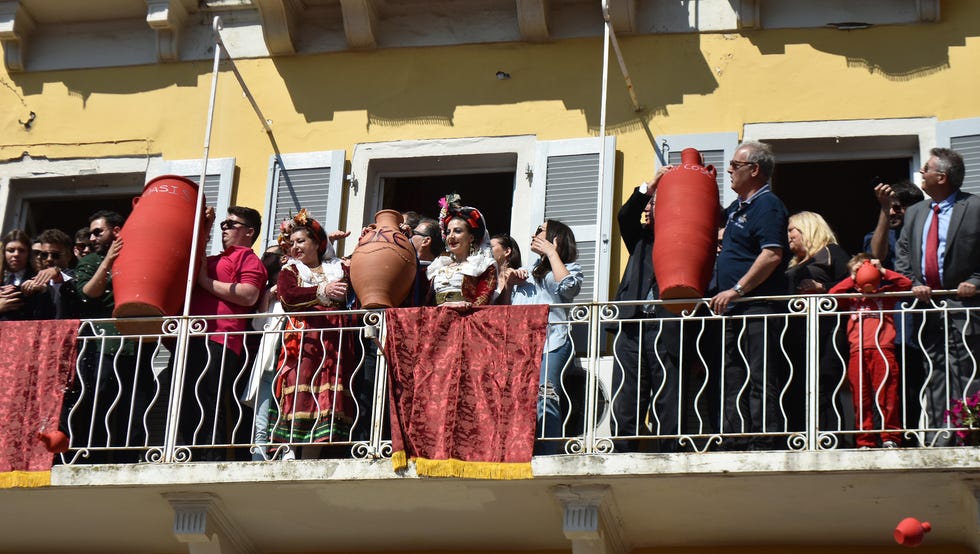
Smashing is a natural local way to celebrate Easter. On Corfu, it is celebrated most spectacularly, where giant clay pots are specially baked for the purpose, which locals shatter by throwing them from balconies. The custom is believed to have been inherited from the Venetians, who on New Year's had the habit of throwing old things out through the terraces. In any case, be careful walking the streets if you are on vacation right during the Easter period.
Like my page on FACEBOOK to be the first to hear about new travel stories and great deals!
Easter in Germany
On Holy Saturday, the "funeral of the Lenten soup zhura" is held, and the herring, which is also part of the Lenten menu, is hung on trees. Pastries made of flour, milk, eggs, and raisins, braided like our kozunak, are baked. Breakfast is invariably a family affair, and children find Easter baskets hidden throughout the house, filled with pastries, chocolate bunnies, and small gifts. The next morning, the whole family gathers for breakfast. Parents hide a basket of sweets. After breakfast, they tell the children: The Easter bunny has brought you a basket and you must find it. The youngsters roam all over the house, and this is the merriest moment of the festive day
Every province has its own customs, but an important part of the festive symbols for Germans is the Easter tree. Its decoration begins at least a week before the holiday itself, with painted hollow eggs tied with colored ribbons hung on its branches. In Bavaria, figures of the rooster are widespread, in Thuringia – of the jay, and in Westphalia – of the fox. To each their own 🙂
A custom in some regions, near the border with Poland and the Czech Republic, is Easter riding. Men can dress formally in tailcoats and ride festively decorated horses from village to village to announce Easter.
Easter in Australia
 Chocolate sweets and eggs are made both very large and miniature, in the shape of the bilby – a pouched animal, a cross between a mouse and a rabbit, which has become an Easter symbol of their country for Australians. The history of the bilby is that the first rabbit brought to Australia set foot on the continent in the late 18th century. Many people started raising them as pets, but quite a few rabbits managed to escape. And since they have no natural enemy in the Australian animal world, and at the same time are known for their rapid reproduction, soon huge herds appeared, attacking fields, villages, and even cities. Therefore, Australians decided to detach themselves from the world by finding their own animal symbol for Easter. And that is the Greater Bilby, or simply Bilby, which twenty years ago managed to be established by the Australian Anti-Rabbit Foundation. So if you are in Australia at Easter, don't be surprised by the strange animal on images and in chocolate wrappers.
The festive menu includes roasted lamb, beef or chicken with grilled vegetables – potatoes, carrots, pumpkin, peas or broccoli. For dessert, the traditional Easter 'Pavlova' cake made from meringue, decorated with kiwi, strawberries, pineapples and mandarins, is served. Very popular are the hot cross buns, which Australians have for breakfast before church.
Easter in Cyprus
Just like here, eggs are dyed in Cyprus as well. Cypriots have a custom of lighting huge bonfires in school or church yards. This can be noticed in many neighborhoods in Cyprus on Easter. Neighborhoods also compete with each other whose fire is bigger. As you can guess, these celebrations often end with a call to the fire department. In places around Cyprus, you can see people burning a doll representing Judas – the apostle who betrayed Jesus.
Easter in New Zealand
In New Zealand, the most famous tradition is the Easter Show in Auckland. The Easter-themed show dates back to the 19th century and includes a number of interesting events, such as sporting events, exhibitions, many shops and other entertainment. Auckland is the most populous city in New Zealand and the show is among the most visited annual events in the city. Perhaps this is also the reason why the Easter show has been commercialized in recent years.
Easter in USA
In the USA, families also make sure to visit the church. The lunch afterwards consists of ham with pineapple, potatoes, fruit salads and greens. The children receive baskets that the 'Easter Bunny' has filled with colorful eggs, chocolates and candies early in the morning.
В САЩ се празнува с множество паради, най-големият е в Ню Йорк, където голяма част от американците носят великденски шапки, а някои роди са дегизирани като зайци. “Пето Авеню” се превръща в същинска карнавална улица. В Америка е много популярна играта,в която малчуганите се надпреварват да търкалят боядисаните яйца по наклонеа ливада. Най-голямото състезание се устройва на поляната до Белия дом, където идват стотици малчугани да търсят скрити великденски яйца и да си поиграят с тях в градината. На края американският президент се вживява в ролята на Дядо Коледа, но през пролетта и подарява на всички дечица по едно дървено великденско яйце, подписано лично от него и от първата дама.
Interesting, however, is the custom in the state of Louisiana. In Bulgaria, it is widely spread the claim that we are the only country where people tap eggs together on the occasion of Easter. It turns out that this is not the case – this custom exists in the state of Louisiana, USA. Competitions to determine which egg is the fighter have been held in the state since the 1950s. The competitions are held on Easter and if a participant's egg breaks even on one side, they are eliminated.
Easter in Hungary
In Hungary, men sprinkle women from their family and friendly circle with 'locsolkodás' cologne, where young people have to water a girl with perfume, after which they have the right to ask for a kiss. If it seems strange to you – the young people are doing a favor to the girls, because it is believed that watering with water brings health and fertility. Nowadays, however, this historical tradition is more of an occasion for mass fun, watering, drenching and soaking.
If you also want to get back a portion of what you spent on hotels, flights, or products, register at this link HERE and every new user receives up to a $10 bonus in their account.

Easter in France
In Paris, they make traditional handmade chocolate bells. On Good Friday in Brittany, forget-me-nots – the flowers of the Greek goddess Persephone – are planted. As a whole, in France it is accepted to go out on a picnic in nature, and the main dish for the holiday is omelet. In southern France, an omelet of 15,000 eggs is made, which has little to do with Easter and a lot to do with Napoleon's culinary preferences.
The French celebrate the holiday, which they call 'Pâques', in a very solemn way. From Good Friday to Sunday, all church bells stop ringing. This is done as a sign of grief over the crucifixion and death of Christ. On Sunday, early in the morning, the bells start ringing again. In France, parents also hide eggs in various places in the house or yard, and children have to look for them. For the festive meal, the French prepare the mandatory roasted lamb, but also traditional biscuits in the shape of a lamb. They are popular mostly in the Lorraine region, but are made all over the country.
Another strange French tradition also includes flying objects – originally these are raw eggs that children toss and catch. Whoever drops their egg and breaks it must distribute candy to the others.
Easter in Brazil and Latin America
At the other end of the world, they like to emphasize the fact that led to the crucifixion of Jesus Christ on the cross and to remind themselves and others that no one likes traitors. Tradition dictates that during the festive marches, rag dolls resembling Judas – Christ's disciple who betrayed him for 30 silver pieces – should be demonstratively burned.
Over time, this has changed and now these are often effigies of real people symbolizing evil. The figures of former American President George Bush, Venezuela's Nicolás Maduro have been burned, two years ago Donald Trump was burned in Mexico (due to his anti-immigrant rhetoric), and sometimes they are simply collective images of the mafia or corrupt politicians.
 Easter in the Netherlands

At Easter, the tulips are already in bloom and the fields resemble a true sea of colors. The climax is the flower parade, called Corso, and takes place on the 40-kilometer stretch between the cities of Noordwijk and Haarlem. The cross represents the main symbol of Easter, which is decorated with flowers.
Easter in ICELAND
On the morning of Easter, Icelanders believe that all trolls and wild animals have hidden deep in the forest or underground and therefore will not harm anyone.
Easter in Spain
Easter is considered the most important holiday in Spain. Known as 'Semana Santa' in Spanish, it is an occasion for celebration and fun. Characteristic there are many processions of devout brotherhoods. The celebrations begin with 'Domingo de Ramos', or Palm Sunday, and end with 'Lunes de Pascua', or Easter Monday. Often the participants wear pointed hoods to remind of scenes from the Inquisition. 3-4 meter high figures of Jesus and saints are carried around towns and villages. Some devout Christians even drag iron chains as a way of self-mortification.
-> Browse and book with a discount a budget hotel in Madrid. See HERE!

Easter in Italy
Unlike our Easter customs, which are mainly associated with dyeing eggs, in Italy it has remained only in some separate regions. In many Italian villages and smaller towns, Easter processions are held and Christ's passion is reenacted. The Pope blesses with Urbi et orbi. On the big holiday, Italian Catholics certainly feast on lamb as well. Charcoal-roasted artichoke is served as a side dish. The Italian Easter sweet bread is baked in the shape of a dove and is called 'colomba'.
In the area of Florence, Italy, there is a unique custom called Scoppio del Carro. The custom takes place during the Easter Mass, when a cart full of pyrotechnics and fireworks passes by. The cart has been used for about 500 years and nowadays is escorted by soldiers in 15th-century uniforms. Depending on how the fireworks will explode, it is predicted what the year and harvest will be like – rich or not.
Easter in Poland
In Poland, cold meat snacks are placed on the beautifully decorated Easter table, among which the most popular is white sausage flavored with salt, pepper, nutmeg, garlic and marjoram, and served with beets. Homemade baked goods and sweets are sliced, of which the most delicious are poppy seed strudels and the lamb made of melted sugar in memory of Christ's Resurrection. Only on this holiday is the special bread 'pascha' served, baked from rye flour with yeast. On top, it is greased with lard and decorated with a cross of dough.
 Easter in Russia

Easter in Russia is the biggest holiday of the year and is not coincidentally called the 'King of Days'. Shortly before midnight on Saturday, people put on their newest and nicest clothes and go to church. Just like in Bulgaria, they wait for the Holy Fire at exactly 12 o'clock, from which they light their candle and walk around the temple with it. The men are allowed to ring the bells of the churches whenever they want. Therefore, the week resounds with incessant ringing that maintains the festive mood. Russians also have a special Easter game, where dyed eggs are rolled down special gutters and collide. The goal is to break the opponents' eggs. At the festive meal, by tradition, the housewife must put as many dishes as there were days of the longest fast during the year.
Easter in the Philippines
Every year on Good Friday in the Philippines, and especially in the village of San Pedro Cutud, located 75 km north of the capital Manila, young men reenact the crucifixion of Christ. They climb high hills carrying wooden crosses, and then nail themselves to the crosses on their hands and feet with 5-centimeter nails. They must remain on the cross for at least 5 minutes. The young men view this custom as a form of penance, but the Catholic Church criticizes the ritual. Easter begins with a midnight dinner, which includes traditional local dishes. Children believe they will go deaf if they do not take part in it. One of the most unusual traditions associated with eggs is found on the island of Trinidad. There, the egg white is poured into water, and the future is predicted from it.

Easter in Sweden
The Easter color is yellow. Here, the egg bearer is not the bunny, but the chick (which is closer to the truth :)). Homes are decorated with birch branches.
Easter eggs are made of cardboard, with a large, beautiful candy placed inside each one. Quite unusual is the tradition in Sweden and Finland, where children dress up as magicians and witches and go around homes to collect chocolate eggs and treats. In return, they bless the visited home with willow branches and a special incantation. It resembles Halloween, but isn't. According to history, the tradition blends that of willow branches – symbolizing the welcoming of Jesus to Jerusalem – and a local Scandinavian tradition of driving away evil spirits.
Easter in Switzerland
In French-speaking Switzerland, springs are decorated with garlands of painted eggs, branches, and ribbons. Strange is also the ancient custom during Holy Week of church bells leaving the country to "go" to Rome. They return at Easter, and chocolate bells and seashells are given to the children met along the way.
Easter in Finland
Finns welcome Easter with the traditional bread "pasha", which for them is a type of cottage cheese and cream cheesecake pressed into a special frustum-shaped vessel. Another very old and specific Finnish sweet pastry is mämmi. It is made from rye flour with browned dark malt and baked in cardboard boxes reminiscent of tree bark. Ready-made mämmi is served as a dessert with cream and sugar.
 Easter in Ukraine
Painted Easter eggs from Ukraine are known all over the world by the name "pysanky". They are painted on raw eggs, the insides of which are removed through tiny holes at both ends of the egg. The designs are made with melted beeswax using a special tool called a "pysachok". Every element painted on the pysanky has its own meaning. The abundance of symbols spans several thousand, which can be grouped into the following categories: geometric figures, Christian symbols, flowers, animals and birds, fish.
Easter in Israel
Thousands of worshippers and tourists travel from all over the world to celebrate this holy holiday in Jerusalem. The Holy Fire and candles symbolize the resurrection of Jesus Christ. It is believed that the day before the holiday, the Holy Spirit descends to earth and lights the candle of one of the patriarchs who have arrived to receive a portion of it. This heavenly fire is passed from candle to candle and, as it burns for the first few minutes, does not burn.
Easter in Bermuda
On Bermuda, kites are flown because long ago a missionary explained the symbol of the cross through a kite.